Good lighting can make a noticeable difference in photos and videos. Even a capable smartphone camera may produce inconsistent results when the surrounding environment is dark, shadows fall across the face, or the main light source comes from an awkward direction. For people who create social media content, attend video calls, record tutorials, or simply want better-looking personal photos, controlling the lighting can be more useful than constantly changing camera equipment.
A ring light with a phone stand combines two practical functions into one setup: illumination and smartphone positioning. Instead of holding a phone while trying to manage a separate lamp, the user can place the phone in a fixed position and adjust the light around it.
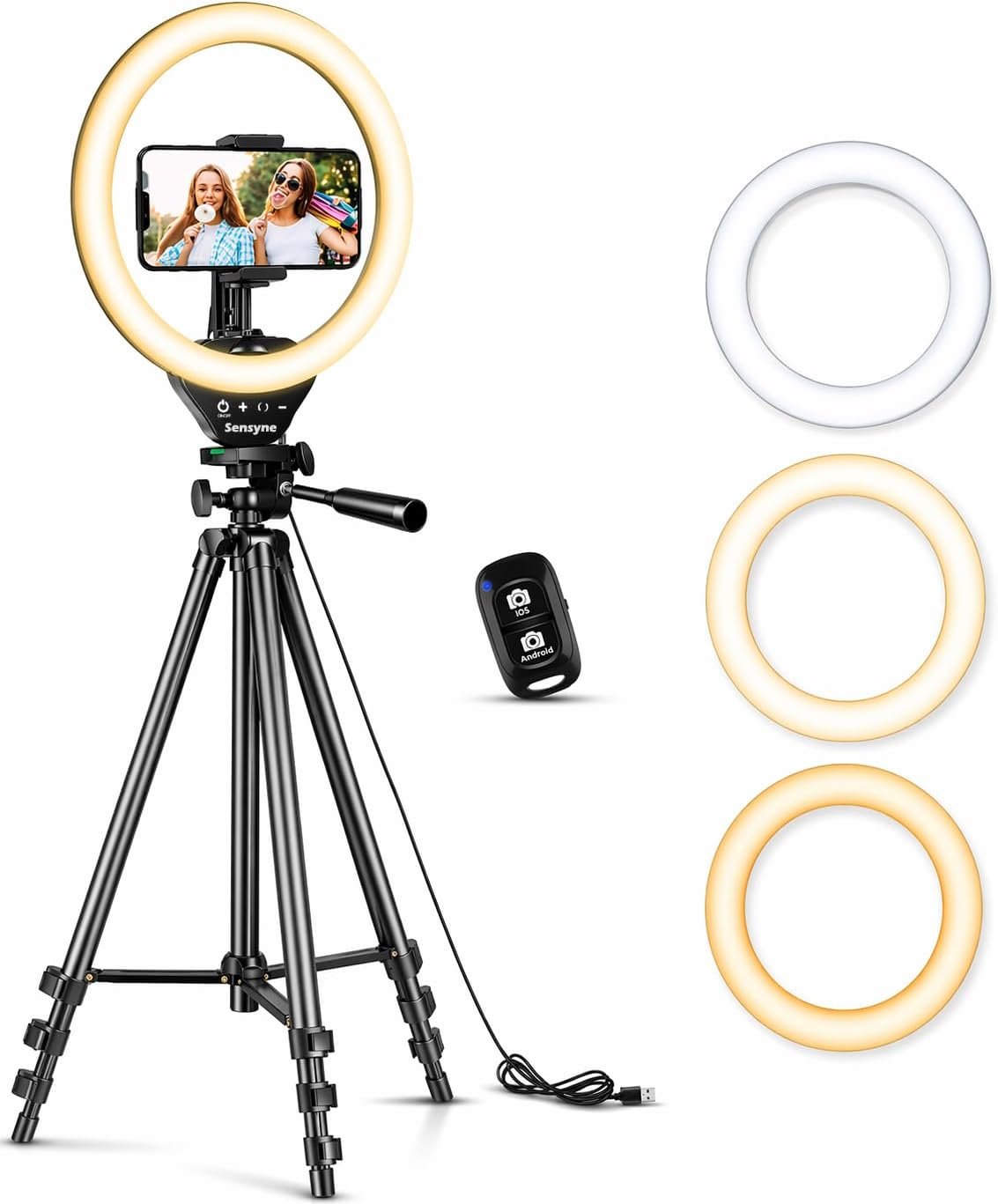
The SENSYNE Ring Light with Stand is designed around this type of setup. The product combines a ring light, a stand reaching up to approximately 50 inches, a phone holder, and a wireless remote intended to provide additional control when taking photos or recording video.
This type of equipment can be useful for a wide range of activities, including social media content, video calls, selfies, livestreaming, product demonstrations, online teaching, makeup application, and casual photography. Its usefulness, however, depends on how the setup is positioned and how the user intends to use it.
This guide explains the main features of a ring light and tripod system, how the SENSYNE setup can be incorporated into different workflows, what users should consider before using one, and how a phone-based lighting stand compares with other common lighting solutions.
What Is a Ring Light With a Phone Stand?
A ring light is a circular light source designed to illuminate a subject from around the camera or phone.
The circular arrangement can help create relatively even front lighting because the light comes from multiple directions around the center opening.
When a smartphone is positioned in the center of the ring, the light can illuminate the person or subject while the phone records or captures the image.
A phone tripod adds another important function: stability.
Instead of holding the phone in one hand, the user can place it in a holder attached to the stand. This leaves both hands available for other activities.
The combination is particularly practical for content creation because the same setup can support lighting, framing, and hands-free recording.
Key Features of the SENSYNE Ring Light With Stand
Ring Light Illumination
The primary purpose of the setup is to provide a dedicated light source for photos and video.
Room lighting is not always positioned in an ideal location. Overhead lights can create shadows under the eyes, while a window may produce strong contrast depending on the time of day.
A ring light can provide a more controlled source positioned directly in front of the subject.
This makes it easier to create consistent lighting across different recording sessions.
Adjustable Stand Up to 50 Inches
The included stand is designed to extend to approximately 50 inches.
A height-adjustable stand provides more flexibility than placing a phone on a desk or holding it manually.
The appropriate height depends on the activity.
For a seated video call, the phone may need to be around face level. For standing content, the stand can be raised higher. For certain tabletop demonstrations, a lower position may be more appropriate.
Being able to change the height also makes the setup easier to adapt to different rooms.
Smartphone Holder
The phone holder keeps a compatible smartphone positioned in front of the ring light.
This is particularly useful for people who record themselves because the camera can remain fixed while the user moves naturally within the frame.
A stable phone position can also make repeated recordings easier because the framing can remain relatively consistent between takes.
Wireless Remote
The included wireless remote provides a way to trigger the smartphone camera without physically touching the phone.
This can be useful when the phone is several feet away on the stand.
For example, someone recording a full-body video would otherwise need to walk back to the phone every time they wanted to start or stop the camera.
A remote can reduce that inconvenience.
Wireless remote functionality can also be helpful for selfies and group photographs.
Users should verify that their specific smartphone and camera application support the remote’s functionality, since Bluetooth camera-control behavior can vary between devices and operating systems.
Compact Content-Creation Setup
One of the main advantages of combining the light, stand, phone holder, and remote is that these components can work together as a single basic content-creation station.
Rather than assembling a separate lamp, tripod, phone mount, and remote, the user can work with one integrated setup.
This can be useful for people who are beginning to create content and want a straightforward arrangement without immediately investing in more specialized studio equipment.
Why Lighting Matters for Smartphone Photography
Modern smartphones can perform well in many lighting conditions, but the camera still depends on the physical environment.
Photography is fundamentally influenced by light.
When a subject is poorly illuminated, the camera may need to increase exposure or use computational processing to produce a usable image. Depending on the circumstances, this can result in more visible noise, softer details, stronger shadows, or uneven skin tones.
Adding a controlled light source can make the camera’s job easier.
The goal is not necessarily to make the image extremely bright. Instead, good lighting aims to place enough light on the subject while maintaining a natural appearance.
A ring light can be particularly useful for front-facing portraits because its position around the camera helps direct light toward the face.
How the SENSYNE Ring Light Can Be Used
Social Media Videos
Social media creators often record content from a fixed location.
A ring light and phone stand can make this process more consistent.
The user can position the stand at an appropriate height, place the phone in the holder, adjust the lighting, and record without needing another person to operate the camera.
This can be useful for short-form videos, educational clips, demonstrations, talking-head content, and other formats where the creator remains in front of the camera.
Selfies
A phone stand can also make taking selfies easier.
Instead of holding the smartphone at arm’s length, the user can place it on the stand and use the wireless remote to trigger the camera.
This allows more flexibility with framing and positioning.
It can also be useful for full-body photographs or group pictures where the phone needs to be placed farther away.
Video Calls
Video conferencing is another practical application.
A laptop webcam or smartphone camera may be positioned in a location where the lighting is not ideal.
A dedicated light can improve the illumination on the user’s face, particularly when the room is dim.
The stand can also help position a smartphone at a more natural eye level.
Good video-call lighting does not need to be complicated. A consistent light source placed in front of the user can often be more useful than relying entirely on ceiling lights.
Online Teaching
Teachers, tutors, coaches, and instructors who create educational videos can use a phone-based lighting setup for recording.
The phone can be positioned at a fixed height while the user explains a topic.
For demonstrations, the setup can be repositioned depending on whether the camera needs to show the instructor, a physical object, or a work surface.
The stand’s adjustability can therefore be useful when changing between different types of educational content.
Makeup and Beauty Content
Makeup application and beauty-related content often benefits from relatively even front illumination.
Shadows can make it more difficult to see details around the face.
A ring light positioned at an appropriate height can provide consistent illumination while the smartphone records.
The user can also use the setup as a personal light while applying makeup without necessarily recording.
Product Demonstrations
Small businesses and content creators can use a phone tripod and ring light to demonstrate products.
For example, someone could place a product on a table and position the smartphone so that the object remains centered in the frame.
The light can then be adjusted to reduce unwanted shadows.
For reflective products, however, ring lights can sometimes create visible circular reflections. In those cases, changing the angle or moving the light farther away may help.
Livestreaming
A stable phone position is important for livestreaming.
A tripod reduces the need to hold the phone continuously and allows the creator to remain within a consistent frame.
The ring light can provide dedicated illumination while the wireless remote can be useful for certain camera-control situations.
The exact workflow depends on the livestreaming platform and smartphone being used.
Remote Meetings and Presentations
A phone-based stand can also be useful for informal professional presentations or remote meetings.
The goal is to position the camera at a comfortable height and provide enough front lighting to keep the subject clearly visible.
For people who frequently participate in video meetings, a consistent setup can save time because the same lighting and camera position can be recreated from one session to another.
Who the SENSYNE Ring Light May Be Suitable For
Social Media Creators
People creating regular smartphone-based content may benefit from having a dedicated lighting setup that can remain ready for use.
The combination of a light, phone holder, stand, and remote covers several basic requirements for self-recording.
Beginners in Content Creation
Someone starting with video content does not necessarily need a complete professional studio.
A simple smartphone-based setup can provide a practical starting point for learning framing, lighting, camera positioning, and presentation.
As content requirements become more demanding, users can add microphones, additional lights, backdrops, or other equipment later.
Students
Students can use a phone stand and ring light for presentations, video assignments, online classes, or recording study content.
The hands-free configuration can make it easier to demonstrate physical objects or write on a board while remaining on camera.
Remote Workers
People working from home may use a ring light to improve their appearance on video calls.
This can be especially useful in rooms where natural light changes throughout the day.
Small Business Owners
Small businesses can use smartphones to create product photos, demonstrations, social media videos, and promotional educational content.
A consistent lighting setup can make repeated content production easier.
Makeup Artists and Beauty Creators
The front-facing lighting provided by a ring light can be useful when demonstrating makeup techniques or recording beauty-related tutorials.
Casual Photographers
Even users who do not create professional content can benefit from a hands-free phone camera setup for family photos, group pictures, celebrations, and other occasions.
Important Things to Consider
Lighting Position Matters
Simply turning on a ring light does not guarantee ideal lighting.
Position is important.
For a typical talking-head video, the light can be placed approximately in front of the subject, with the phone positioned within or near the center of the ring.
The height can then be adjusted so that the light is not coming from too far above or below eye level.
Small changes in distance and angle can produce noticeable differences in shadows and reflections.
Distance Affects the Look
A light placed very close to the subject can create stronger illumination, while moving it farther away can produce a different balance.
Users should experiment with distance rather than always keeping the stand at the same position.
A more distant light may provide a wider area of illumination, while a closer light can provide more concentrated brightness.
Room Lighting Still Matters
A ring light does not exist in isolation.
Natural daylight, overhead lights, lamps, windows, and other sources all influence the final image.
Mixing several light sources with different color characteristics can sometimes produce inconsistent results.
For a simple setup, users may find it easier to control the surrounding lighting as much as possible.
Smartphone Compatibility
The phone holder should be checked for compatibility with the user’s device.
Smartphones vary considerably in dimensions and case thickness.
A large protective case may affect how securely a phone fits into a holder.
It is therefore worth checking the holder’s supported size range before setting up the equipment.
Wireless Remote Compatibility
The wireless remote is intended to provide convenient camera control, but compatibility can vary.
Different smartphone operating systems and camera applications can interpret Bluetooth shutter commands differently.
Users should verify that the remote works with their specific phone and preferred camera application.
Stability
A tall tripod becomes more sensitive to movement, particularly if the phone is positioned high above the ground.
The stand should be placed on a stable, level surface.
Users should avoid positioning it where people can easily bump into it.
A stable setup is especially important when using a phone in a heavier case or when the stand is extended to a greater height.
Background and Framing
Lighting is only one part of a good video.
The background, camera angle, subject position, and composition also matter.
Before recording, users should check the entire frame rather than focusing only on their face.
A simple background can help keep attention on the subject, while cluttered surroundings may distract from the content.
Reflections
Ring lights can create visible circular reflections on glasses, glossy surfaces, mirrors, screens, and other reflective objects.
If reflections become distracting, users can experiment with changing the angle or distance of the light.
People who wear glasses may also need to adjust the light slightly to reduce reflections in the lenses.
Not a Complete Studio
A ring light and phone tripod can provide useful basic equipment, but it does not replace every component of a professional studio.
Professional production may require multiple lights, softboxes, dedicated cameras, audio equipment, backgrounds, stands, and other accessories.
The SENSYNE-style setup is more appropriate to the concept of simple, accessible smartphone-based content creation.
Ring Light vs. Desk Lamp
A conventional desk lamp can provide illumination, but its design is usually intended for a work surface rather than photography.
A desk lamp may create stronger shadows because the light comes from one relatively small source.
A ring light surrounds the camera area and is specifically suited to front-facing illumination.
However, a desk lamp can be more versatile for general room lighting and may be useful for tasks that do not involve photography or video.
The choice depends on whether the primary goal is subject illumination or everyday lighting.
Ring Light vs. Natural Window Light
Natural window light can be excellent for photography and video, especially when it is soft and comes from an appropriate direction.
It is also free and requires no additional equipment.
The limitation is consistency.
Sunlight changes throughout the day, weather affects brightness, and the direction of the sun changes over time.
A ring light provides a more predictable artificial source that can be used at night or in rooms without suitable windows.
Many creators combine natural light with artificial lighting rather than treating them as mutually exclusive options.
Ring Light vs. Softbox Lighting
Softboxes are common in more advanced photography and video setups.
Their larger diffusion surfaces can create soft, flattering illumination and provide greater control over the direction and quality of light.
A ring light is generally simpler and more compact.
For smartphone content, video calls, selfies, and basic talking-head videos, a ring light can provide a straightforward solution.
For professional studio work, users may eventually prefer a more flexible multi-light system.
Tripod Phone Stand vs. Handheld Recording
Handheld recording offers flexibility and spontaneity.
It can be useful when moving around or creating informal content.
The disadvantage is that the phone can shake, the framing can change, and one hand remains occupied.
A tripod stand provides stability and repeatability.
It is particularly useful when the user needs both hands available or wants to record from a fixed position.
The two approaches serve different purposes and can easily coexist.
Creating a Simple Smartphone Recording Station
A basic recording station does not need to be complicated.
Start by choosing a stable location with enough space for the tripod.
Position the phone at approximately eye level for talking-head content.
Place the ring light around the camera and adjust the height.
Then check the camera preview.
Look for shadows, reflections, distracting objects, and unwanted bright areas in the background.
If the face appears too bright, the light may be too close or intense. If the image looks dark, moving the light closer or reducing competing background shadows may help.
Once the position works, mark or remember the setup so it can be recreated later.
Consistency can be particularly useful for creators who produce content regularly.
Tips for Better Smartphone Content
Keep the Camera Near Eye Level
For many talking-head videos, positioning the camera around eye level creates a natural perspective.
A camera that is too low or too high can change the appearance of the face and body.
Check the Entire Frame
Do not focus only on the subject.
Look at the background, visible furniture, cables, windows, and other objects.
A clean frame can make even simple content feel more organized.
Avoid Overexposure
More light is not always better.
If highlights become extremely bright and facial details disappear, reduce the light level or increase the distance between the light and subject.
Maintain Consistent Lighting
If multiple videos are part of the same series, try to maintain a similar lighting position.
This creates a more consistent appearance between recordings.
Use the Wireless Remote Strategically
The remote can be particularly useful when the phone is positioned several feet away.
Set up the framing first, then use the remote to trigger the camera when appropriate.
Keep the Tripod Stable
Avoid placing the stand on unstable surfaces.
If the setup is being used in a high-traffic area, position it where it is less likely to be bumped.
Frequently Asked Questions
What is the SENSYNE Ring Light with Stand designed for?
It is designed as a smartphone-oriented lighting and camera-positioning setup. The combination of a ring light, adjustable stand, phone holder, and wireless remote can support photography, video recording, video calls, social media content, and other hands-free smartphone applications.
How tall is the stand?
The product is described as having a stand that extends to approximately 50 inches. Actual working height depends on how the stand is adjusted and how the phone is positioned.
Can it be used for video calls?
Yes, a ring light and phone stand can be useful for video calls by providing controlled front lighting and keeping the phone at a stable position.
Is the wireless remote useful for selfies?
It can be useful for compatible smartphones because it allows the user to trigger the camera without physically holding the phone. Compatibility with the specific phone and camera application should be confirmed.
Can the setup be used for TikTok or other social media videos?
A phone tripod and ring light can be used for many forms of social media video, including vertical content. The user simply needs to position the phone appropriately for the desired orientation and framing.
Can it be used for full-body photos?
The adjustable stand and remote can make full-body photography more practical because the phone can be positioned farther away while the user remains hands-free.
Is a ring light better than natural light?
Not necessarily. Natural light can produce excellent results, but it changes throughout the day. A ring light provides a more controlled and repeatable artificial source. The best choice depends on the environment and intended use.
Does a ring light eliminate shadows?
A ring light can reduce certain facial shadows by providing relatively even front illumination, but it cannot eliminate every shadow. Room lighting, subject position, distance, and surrounding objects all affect the final result.
Can people who wear glasses use a ring light?
Yes, but reflections can occur on eyeglasses. Adjusting the angle, height, or distance of the light can sometimes reduce unwanted reflections.
Can a phone case affect the phone holder?
It can. Thick or unusually large cases may affect how securely a phone fits into a holder. Users should verify the holder’s supported phone dimensions.
Is a ring light enough for professional video production?
It can be useful for basic content creation, but professional productions may require additional lighting, audio equipment, cameras, backgrounds, and other tools.
Can the ring light be used without recording video?
Yes. A dedicated light can also be useful for selfies, makeup application, video calls, online meetings, product work, or general close-range illumination.
Where should a ring light be placed for a video?
For many talking-head situations, placing the light in front of the subject and keeping the camera near the center of the light provides a useful starting point. Height and distance can then be adjusted according to the desired appearance.
Why does lighting change the appearance of smartphone photos?
Lighting determines how shadows, highlights, colors, and facial details appear. A controlled light source can make the subject more evenly illuminated and can help the smartphone camera capture the scene more consistently.
Conclusion
The SENSYNE Ring Light with Stand combines several simple tools that are useful for smartphone-based photography and video: a ring light for controlled front illumination, an adjustable stand for positioning, a phone holder for hands-free recording, and a wireless remote for compatible camera control.
The combination can support many everyday applications, from social media videos and selfies to video calls, online teaching, product demonstrations, livestreaming, and remote work.
The biggest advantage of a setup like this is not any single component by itself. It is the way the components work together. A stable phone position makes framing easier, dedicated lighting can improve consistency, and a wireless remote can make hands-free recording more convenient.
At the same time, good results depend on how the equipment is used. Lighting position, distance, room conditions, phone compatibility, tripod stability, background composition, and reflections all matter. A ring light is a useful tool, but it does not automatically produce professional-looking content without attention to the rest of the setup.
For beginners, a simple phone-based lighting station can provide a practical way to learn the fundamentals of lighting, framing, and recording without requiring a complicated studio. More experienced creators can also use a compact ring-light setup as a secondary station or a convenient solution for quick recordings.
Whether the goal is improving video calls, creating social media content, taking hands-free photos, or building a basic home recording space, understanding how the light, stand, phone, and remote work together can help users get more value from this type of equipment.