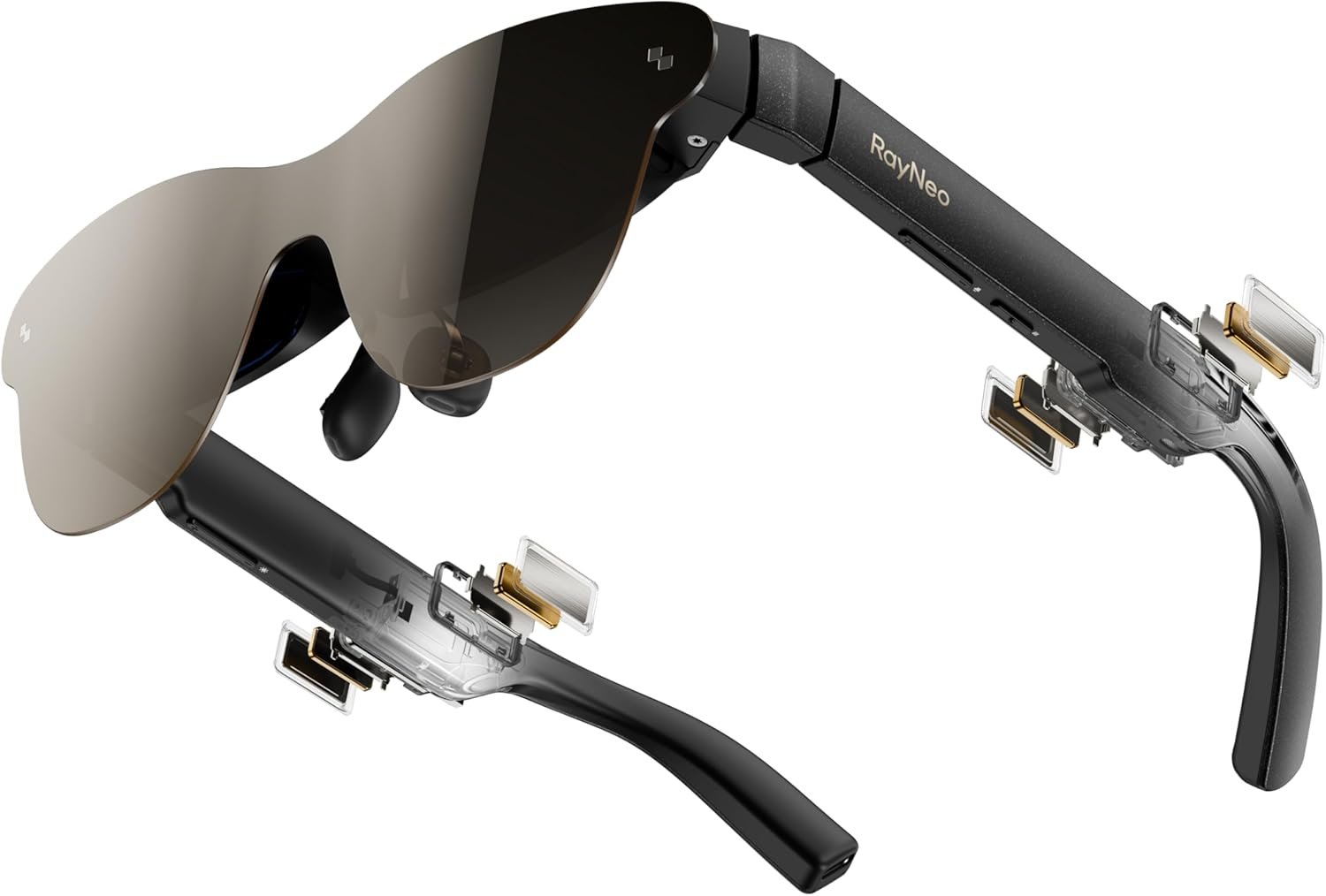
The way people consume digital content is changing as displays become smaller, lighter, and increasingly portable. Smartphones, tablets, laptops, televisions, and gaming monitors each have their own advantages, but they all require users to look at a physical screen. AR and XR glasses approach the problem differently by placing display technology directly in front of the user’s eyes while maintaining a glasses-like form factor.
The RayNeo Air 3s Pro AR/XR Glasses are designed around this concept. The product combines a wearable display with technologies intended to create a large virtual viewing experience without requiring a physically large television or monitor. The listed specifications include a 201-inch virtual display, up to 120Hz refresh rate, 1200 nits brightness, and HueView 2.0 display technology.
These specifications are particularly relevant for people interested in portable entertainment, gaming, productivity, travel, and personal viewing. Instead of carrying a large monitor, a user can potentially connect compatible devices to a pair of display glasses and view content through the wearable display.
Understanding products in this category requires looking beyond individual numbers. A large virtual screen does not mean the glasses physically contain a 201-inch panel, for example. Similarly, brightness, refresh rate, resolution, color performance, compatibility, comfort, and connection methods all contribute to the overall experience.
This guide explains how the RayNeo Air 3s Pro fits into the AR/XR glasses category, what its listed display features mean, how this type of wearable screen can be used, and what prospective users should consider before incorporating it into their technology setup.
What Are AR and XR Display Glasses?
AR and XR glasses are wearable computing or display devices designed to place digital content within the user’s field of view.
Although the terminology can vary between manufacturers, the general concept is different from simply wearing a conventional pair of glasses.
A display system inside the glasses presents visual content to the wearer. Depending on the product and its capabilities, the glasses may function primarily as a private virtual display for connected devices rather than as a fully independent augmented-reality computer.
This distinction is important.
Some people hear “AR glasses” and imagine digital objects being freely projected throughout a physical room. Other products in the category are primarily designed to provide a large virtual screen for movies, games, applications, or desktop content.
The RayNeo Air 3s Pro is particularly relevant to the second type of use case: using wearable display hardware to create a large personal viewing environment.
The concept can be especially interesting when physical screen size is limited.
A laptop may have a relatively compact display. A handheld gaming device has an even smaller screen. A smartphone is smaller still. Display glasses can provide a different viewing format by presenting content through optics positioned close to the user’s eyes.
Understanding the 201-Inch Virtual Display
One of the most prominent specifications associated with the RayNeo Air 3s Pro is its advertised 201-inch virtual display.
It is important to understand what this number means.
The glasses do not contain a physical 201-inch screen. Instead, the display system creates the visual impression of a much larger screen positioned at a virtual distance.
This is similar to the idea of sitting in front of a large cinema screen without physically having a cinema-sized panel in the room.
The benefit of a large virtual display is primarily the sense of scale.
A movie viewed on a smartphone may require the user to concentrate on a relatively small physical screen. A wearable display can make the same type of content appear much larger within the user’s visual field.
For gaming, a larger perceived screen can also change how the interface feels. Elements that appear compressed on a handheld display may become easier to view when presented through a larger virtual canvas.
The virtual screen concept is therefore one of the main reasons wearable displays can complement existing devices.
120Hz Refresh Rate Explained
Another notable specification is the 120Hz refresh rate.
Refresh rate describes how frequently a display can update the image each second. A 120Hz display can refresh up to 120 times per second under appropriate conditions.
Higher refresh rates can contribute to smoother perceived motion, particularly when the source device and content can provide the necessary frame rate.
This can be relevant for:
- Gaming
- Fast-moving video
- Scrolling interfaces
- Interactive applications
- General visual responsiveness
However, a 120Hz capability does not automatically mean every piece of content will run at 120Hz.
The source device, application, connection, video format, and other technical factors can affect the actual experience.
For example, a movie created at a lower frame rate does not become native 120Hz content simply because the display is capable of refreshing at 120Hz.
The practical advantage of a higher refresh-rate display is therefore most noticeable in situations where the content and connected hardware can make use of it.
Understanding the 1200-Nit Brightness Specification
Brightness is another important consideration for wearable displays.
The RayNeo Air 3s Pro is listed with a brightness specification of up to 1200 nits.
A nit is a unit used to describe luminance. In simple terms, a higher brightness capability can help a display remain visible in brighter environments.
This is particularly relevant to wearable displays because users may not always be sitting in a completely dark room.
However, brightness specifications should be interpreted carefully.
Maximum brightness is not necessarily the brightness used continuously in every situation. Actual perceived visibility can also depend on ambient lighting, optical design, lens characteristics, contrast, content, and other factors.
Higher brightness can be useful for improving visibility, but it is not the only factor that determines display quality.
For comfortable long-duration viewing, users may also want to consider room lighting and personal viewing preferences.
HueView 2.0 Display Technology
HueView 2.0 is another technology associated with the RayNeo Air 3s Pro display system.
Display technology is more complicated than a single brightness or refresh-rate number. Color reproduction, contrast, visual consistency, image processing, and optical characteristics all contribute to what the user ultimately sees.
A display technology such as HueView 2.0 can therefore be considered part of the broader visual system rather than an isolated feature.
For users interested in movies, games, digital content, and other visually detailed applications, color presentation can influence how immersive the virtual screen feels.
At the same time, specifications alone cannot fully describe how every type of content will appear. Different applications can use different color profiles, brightness levels, and image characteristics.
Key Features of the RayNeo Air 3s Pro
Large Virtual Viewing Experience
The 201-inch virtual display specification is intended to create the perception of a large personal screen.
This can be useful for users who want a cinema-like viewing scale without carrying a large physical display.
The concept can be especially practical when traveling, staying in temporary accommodation, or using compact workspaces.
120Hz Display Capability
A refresh rate of up to 120Hz can support smoother motion when compatible content and source hardware provide suitable frame rates.
This makes the glasses potentially relevant to gaming and other interactive applications where motion responsiveness matters.
Up to 1200 Nits Brightness
The listed brightness capability can help support visibility in different viewing environments.
Users should nevertheless consider ambient lighting and the other elements of display performance rather than evaluating the glasses based on brightness alone.
Wearable Form Factor
One of the central advantages of display glasses is their physical format.
Instead of carrying a separate monitor, the user wears the display.
This can make the concept attractive to people who travel frequently or work with devices that have relatively small screens.
Personal Viewing
A wearable display can provide a more private viewing experience than a conventional television or monitor.
The user can potentially view compatible content without requiring a large screen to occupy a shared room.
This can be useful in situations where other people are nearby or where physical space is limited.
Compatibility With External Devices
AR/XR display glasses generally depend on compatible external hardware for many use cases.
Depending on the connection and device involved, users may connect display glasses with computers, gaming hardware, smartphones, handheld systems, or other compatible sources.
Compatibility should always be checked for the specific device rather than assumed simply because both products use USB-C or another common connector.
How the RayNeo Air 3s Pro Can Be Used
The flexibility of a wearable display comes from the fact that the glasses can serve as a screen for different types of content.
Watching Movies and Video
Personal entertainment is one of the most straightforward applications.
A large virtual display can make movies, television programs, streaming content, and other video feel more like a large-screen viewing experience.
This can be particularly useful during travel.
Instead of carrying a portable monitor, users can potentially use the glasses with compatible equipment to create a personal viewing environment.
The experience can also be useful at home when a user wants a large virtual screen without installing a television.
Gaming
Gaming is another major application for display glasses.
A handheld gaming device normally places the game on a relatively small physical display. A compatible wearable display can potentially present the game’s image on a much larger virtual screen.
The 120Hz capability is particularly relevant to gaming because higher refresh rates can support smoother motion when the game and source hardware support appropriate frame rates.
Different gaming devices have different connection requirements, so users should verify compatibility before planning a particular setup.
Portable Gaming
Portable gaming is especially interesting because physical screen size is often limited by the need to keep a device compact.
A handheld console can remain small enough to carry while the wearable display provides a much larger viewing experience.
This can be useful for travel, hotel rooms, or other situations where carrying a full-size monitor would be inconvenient.
Laptop Productivity
A wearable display can also function as an alternative viewing screen for compatible computers.
For example, someone working from a laptop in a limited space may appreciate having a large virtual display without carrying a separate monitor.
Depending on the user’s setup, this could be useful for reading documents, browsing the web, viewing dashboards, coding, or working with other applications.
However, productivity requirements can be more demanding than simple entertainment.
Users who spend many hours reading small text should pay close attention to visual clarity, comfort, fit, and the overall viewing experience.
Travel
Travel is one of the situations where wearable displays can make practical sense.
A physical monitor adds weight and occupies luggage space. Display glasses can provide an alternative for users who want access to a larger personal screen while traveling.
A traveler could potentially use compatible equipment to create a personal entertainment setup in a hotel room, on a long trip, or in another temporary environment.
Connection accessories should be considered as part of the overall travel setup.
Working in Small Spaces
People living or working in smaller spaces may not want a large television or monitor permanently occupying a desk or wall.
A wearable display can provide access to a large virtual viewing area without requiring a corresponding physical screen.
This can make the concept attractive for compact apartments, dorm rooms, temporary workspaces, or shared environments.
Watching Content Privately
A conventional television is inherently a shared display.
Wearable glasses provide a more individual viewing format.
Someone working in a shared room can potentially use a personal display without occupying the main television.
This can be useful when household members have different schedules or entertainment preferences.
Who the RayNeo Air 3s Pro May Be Suitable For
Gamers
Gamers who use compatible devices may be interested in wearable displays because they can provide a larger viewing environment while maintaining a portable setup.
The 120Hz capability can also be relevant to games capable of taking advantage of higher refresh rates.
Frequent Travelers
Travelers may appreciate the ability to carry a wearable display instead of a separate portable monitor.
The smaller physical form factor can make personal entertainment more flexible when away from home.
Laptop Users
People who frequently work from laptops may find the idea of a large virtual screen useful when physical desk space is limited.
The glasses can potentially provide another way to view compatible computer content.
Entertainment-Focused Users
People who primarily want a personal large-screen experience for movies and video may find the wearable-display concept particularly interesting.
The virtual display can provide a different viewing experience from a smartphone or tablet.
Technology Enthusiasts
AR/XR glasses are part of a rapidly developing category of personal display technology.
Technology enthusiasts may be interested in experimenting with wearable screens, portable gaming setups, and alternative computing workflows.
Important Things to Consider
Device Compatibility
Compatibility should be one of the first things to verify.
A wearable display is only useful if it can connect correctly to the hardware a person intends to use.
USB-C does not necessarily mean that every USB-C device supports the required video output.
Before purchasing or planning a setup, check the requirements of the specific computer, phone, gaming device, adapter, or other source device.
Physical Comfort
Display glasses are worn directly on the face, so comfort matters.
Factors can include:
- Frame fit
- Weight distribution
- Nose support
- Temple pressure
- Cable placement
- Lens positioning
- Personal facial dimensions
A specification sheet cannot determine how comfortable a particular frame will feel for every person.
This is especially important for long movie sessions or extended work periods.
Vision and Prescription Needs
People who wear prescription glasses should consider how a wearable display interacts with their normal eyewear.
Depending on the design and available accessories, prescription solutions may be possible, but users should verify compatibility rather than assume that their existing glasses can simply be worn underneath the device.
Brightness and Viewing Environment
Although the listed 1200-nit capability can provide substantial brightness, ambient lighting still matters.
Users should consider where they expect to use the glasses.
A darker indoor environment may produce a different viewing experience from a brightly illuminated room.
Refresh Rate Depends on the Source
The 120Hz specification describes the display’s capability, but the connected device and content must also support appropriate output.
A low-frame-rate video will not automatically become high-frame-rate content.
Similarly, gaming performance depends on the source hardware and game settings.
Battery and Connected Equipment
Depending on the intended configuration, users should consider how the glasses receive power and how the source device connects to them.
Portable setups can require cables, adapters, power banks, or other accessories.
A complete travel configuration should therefore be considered rather than evaluating the glasses independently from the rest of the equipment.
Field of View and Virtual Screen Size
A very large virtual screen does not mean the user sees every part of a 201-inch screen in exactly the same way as sitting in front of a physical television.
The virtual display is created through optics and has a defined field of view.
Users who are particularly interested in immersive viewing should understand the distinction between advertised virtual screen size and physical panel dimensions.
Motion and Personal Comfort
Some people may experience discomfort when using wearable displays for extended periods.
Factors such as visual focus, movement, brightness, content, and individual sensitivity can affect comfort.
New users may benefit from shorter sessions at first and adjusting the viewing environment to their preferences.
If a user experiences persistent discomfort, taking a break and discontinuing use until the issue is understood is sensible.
Comparing Wearable Displays With Portable Monitors
A portable monitor and AR/XR glasses can both solve a similar problem: providing additional screen space away from a traditional desktop.
A portable monitor has the advantage of being a conventional physical screen. Multiple people can generally view it, and it can behave much like a normal monitor.
Wearable glasses have a different advantage.
They can create a large personal display without requiring a large physical panel.
This makes them particularly interesting for individual viewing and travel.
The choice depends on whether the user values shared physical visibility or private wearable viewing.
Comparing AR/XR Glasses With VR Headsets
AR/XR glasses and VR headsets can overlap in terminology but provide different physical experiences.
VR headsets typically cover more of the user’s field of view and are designed around immersive virtual environments.
Display glasses generally resemble eyewear more closely and can focus on providing a virtual screen while remaining relatively lightweight and portable.
For watching a movie or using a laptop screen, a glasses-style display may be more convenient for some users.
For fully immersive virtual reality applications, a dedicated VR headset may be more appropriate.
Neither category automatically replaces the other.
Comparing Wearable Displays With Smartphones and Tablets
Smartphones and tablets are highly versatile because they include their own computing hardware, batteries, touchscreens, cameras, applications, and connectivity.
Wearable display glasses are more specialized.
They can provide a larger apparent viewing area while depending on compatible external devices for many tasks.
A tablet may therefore be more convenient for reading, browsing, or general standalone use, while display glasses may be more appealing when the goal is creating a large private screen from an existing device.
Comparing 60Hz and 120Hz Displays
Refresh rate is another area where users may encounter significant differences between devices.
A 60Hz display refreshes up to 60 times per second, while a 120Hz display can refresh up to 120 times per second.
Higher refresh rates can make motion appear smoother when content supports the higher rate.
The difference can be particularly noticeable in interactive applications and games.
However, refresh rate should not be considered independently from resolution, image quality, connection bandwidth, source hardware, and software.
A display is a complete system rather than a single specification.
Practical Setup Ideas
A wearable display can become more useful when it is integrated into a deliberate setup.
For gaming, users might create a compact configuration consisting of a compatible handheld or computer, the glasses, the necessary connection hardware, and an appropriate power source.
For travel, the setup could be organized around minimal accessories and reliable charging.
For productivity, users may prefer a desk arrangement that allows the glasses to act as an additional or alternative screen.
The key is to identify the primary use case first.
Someone buying wearable glasses mainly for gaming will have different requirements from someone who wants them primarily for watching movies or working from a laptop.
Caring for Wearable Display Glasses
Because the device is worn close to the eyes, keeping the optical surfaces clean is important.
Users should follow the manufacturer’s cleaning instructions and use appropriate materials rather than applying aggressive chemicals or abrasive materials to the lenses.
The glasses should also be stored in a way that protects them from unnecessary pressure, scratches, moisture, and impact.
Cables and connectors deserve attention as well, particularly when the glasses are frequently transported.
A protective case can be useful when carrying wearable electronics between locations.
Frequently Asked Questions
What are the RayNeo Air 3s Pro glasses designed to do?
The RayNeo Air 3s Pro is a wearable display product designed to provide a large virtual viewing experience. It can be relevant to entertainment, gaming, portable computing, and other applications involving compatible external devices.
Is the 201-inch display physically 201 inches?
No. The 201-inch specification refers to the perceived or virtual display size created by the optical display system. The glasses themselves obviously do not contain a physical 201-inch panel.
What does 120Hz mean?
A 120Hz refresh rate means the display can refresh up to 120 times per second under supported conditions. Higher refresh rates can provide smoother motion when the source device and content support them.
Does every game automatically run at 120Hz?
No. The actual refresh rate and frame rate depend on the connected hardware, software, game, settings, and connection configuration.
What does 1200 nits mean?
Nits are a measurement of luminance. A maximum brightness specification of 1200 nits indicates the display can reach a high level of brightness under appropriate conditions. Actual brightness during use can vary depending on settings and circumstances.
What is HueView 2.0?
HueView 2.0 is part of the display technology associated with the RayNeo Air 3s Pro. It is intended to contribute to the visual characteristics of the wearable display system, including aspects of color and image presentation.
Can these glasses be used for gaming?
They can be relevant to gaming when connected to compatible gaming hardware. Portable gaming is one of the potential use cases for wearable displays because the glasses can provide a larger virtual viewing environment than the physical screen on many handheld devices.
Can they be used with a laptop?
A compatible laptop and connection configuration may allow the glasses to function as a personal display. Compatibility should be checked for the specific computer and port configuration.
Are wearable display glasses the same as VR headsets?
Not exactly. VR headsets generally focus on immersive virtual environments, while display glasses can focus more heavily on providing a large virtual screen in a glasses-style form factor.
Are they useful for travel?
They can be useful for travelers who want a large personal display without carrying a conventional monitor. The practicality of a travel setup depends on the source device, cables, power requirements, and other accessories.
Can people around me see the screen?
A wearable display is intended primarily for the person wearing it. However, users should not assume that every display is completely invisible to people nearby. Privacy characteristics can vary based on viewing angle, brightness, environment, and optical design.
Are AR/XR glasses suitable for long work sessions?
Suitability varies from person to person. Comfort, fit, optical characteristics, brightness, and individual sensitivity all matter. People planning extended use should pay particular attention to ergonomics and take regular breaks.
Do I need a separate computer to use the glasses?
The exact requirements depend on the intended use and compatible devices. Display glasses are not necessarily equivalent to standalone computers, so users should check which functions can operate with their intended source device.
What should I check before connecting the glasses to a device?
Check video-output compatibility, supported connection standards, power requirements, adapters, software requirements, and any device-specific limitations. A connector that physically fits does not always guarantee video compatibility.
Conclusion
The RayNeo Air 3s Pro AR/XR Glasses illustrate how wearable displays can provide an alternative to conventional screens. Instead of carrying a large monitor, users can wear a compact display system capable of creating a much larger perceived viewing environment.
The advertised 201-inch virtual display is particularly relevant to the concept, offering a cinema-style scale from a wearable form factor. The listed 120Hz refresh rate can be valuable for compatible gaming and other motion-sensitive applications, while the up-to-1200-nit brightness specification addresses another important part of display performance. HueView 2.0 adds to the overall display technology behind the visual experience.
However, specifications should always be considered as part of a larger system.
Compatibility with source devices, comfort, viewing conditions, connectivity, power requirements, field of view, content frame rate, and individual preferences can all influence how useful wearable display glasses become in practice.
For gamers, travelers, laptop users, entertainment enthusiasts, and technology users interested in personal displays, the category offers an interesting alternative to traditional monitors and televisions.
The most useful approach is to start with the intended application. Someone looking for a portable movie screen may have different priorities from someone interested in high-refresh-rate gaming or laptop productivity. Once the primary use case is clear, display specifications and compatibility requirements become much easier to evaluate.
Wearable displays are not necessarily designed to replace every conventional screen. Instead, they provide another way to access digital content, particularly when portability, personal viewing, and large virtual screen size are important.
Leave a Reply